

He said what a lot of people think but don’t say out loud:
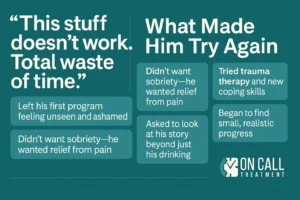
“This stuff doesn’t work. I’ve done it before. Total waste of time.”
He wasn’t hostile. Just tired. Tired of being told he had a “disease.” Tired of 12-step slogans that didn’t land. Tired of people looking at him like he was broken.
He’d tried alcohol addiction treatment before. Left early. Relapsed. Swore he was done with the whole “recovery” scene. And for a while, he was.
But something happened—quietly, unexpectedly—that made him try again.
And this time? It landed.
At On Call Treatment in Waltham, MA, we’ve met a lot of folks like him. People who don’t want another pep talk or empty promise. Just something that works.
What He Really Meant Was: “I Don’t Want to Hope Again”
The first time he went to treatment, he wanted to believe. He wanted it to work.
But what he got was a rigid system with no room for nuance. A place that said “addict” like it was his name. A plan that didn’t ask why he drank—just told him to stop.
He left feeling unseen, misunderstood, and ashamed that it didn’t “stick.”
So by the time he walked into our doors, his walls were up. He wasn’t angry. Just done.
He told us flat-out:
“Don’t try to fix me. I just want to drink less—not join a cult.”
And honestly? We respected that.
He Didn’t Want Sobriety. He Wanted Relief.
Let’s be real: most people don’t walk into treatment saying, “Please take everything I know and rebuild me from the ground up.”
They come in because they’re hurting. Because something in their life isn’t working anymore. Because they’re tired of lying, hiding, hurting the people they love—or themselves.
This man? He was sleeping four hours a night. His job was on thin ice. His hands shook every morning. He’d stopped looking people in the eye.
He didn’t want to be sober. He wanted to feel okay again.
And we told him the truth: That’s a fine place to start.
What Didn’t Work the First Time (And Why It Happens Often)
He wasn’t believed. Not really.
In his first program, they gave him a schedule, a “sponsor,” and a thick packet of rules. But no one asked him about his panic attacks. No one listened when he said crowds made him spiral. No one acknowledged the trauma behind his drinking.
He felt like a liability, not a person. A “case,” not a man trying to survive his own thoughts.
That’s not uncommon. Too many programs push cookie-cutter recovery without asking what someone’s actual life looks like.
At On Call Treatment, we do it differently.
What Changed the Second Time Around
This time, he didn’t come in hopeful. He came in exhausted. But also—just open enough to try something new.
And that was enough.
Instead of handing him a list of things to “do,” we asked one question:
“Can we look at your whole story, not just your drinking?”
That shifted everything.
He started trauma therapy. He got proper anxiety meds. He met with people who didn’t flinch when he got raw. He built real coping skills instead of getting lectures.
And for the first time, he felt something shift—something small but real.
Progress Looked Like a Tuesday Without Regret
It wasn’t dramatic.
No bright light epiphany. No tearful declarations. Just a Tuesday where he woke up and realized he hadn’t reached for a drink the night before. And didn’t hate himself for it.
That moment meant more than any milestone chip could’ve.
He said:
“I thought I had to be ready to quit forever. But maybe I just had to be ready to try today. That feels doable.”
That’s the thing most people miss. Recovery doesn’t always start with belief—it starts with barely enough. And that’s plenty.
We Didn’t Sell Hope. We Built It
At On Call Treatment, we don’t throw around words like “transformation” or “rock bottom.”
We meet people in the middle—where they’re skeptical, wounded, and unsure this is worth the effort.
Instead of preaching, we:
- Normalize resistance
- Focus on stabilization before reinvention
- Use trauma-informed care and evidence-based tools
- Provide flexible support (IOP, PHP, and more) based on real life, not rules
- Offer respect, not lectures
Because trust isn’t automatic—it’s earned. And most people who walk through our doors have been burned before.
What He Has Now (That He Didn’t Have Before)
He still has cravings sometimes. He still gets anxious in groups. He still doesn’t love labels.
But now?
- He knows how to pause before he drinks
- He’s sleeping through the night
- He talks to his kids again
- He’s rebuilding—not erasing—his life
And when someone says “treatment doesn’t work,” he shrugs and says:
“That’s what I thought too. But this time was different.”
FAQs About Alcohol Addiction Treatment (for People Who Don’t Believe in It)
What if I’ve been to rehab before and it didn’t help?
You’re not alone. Many people need a second—or third—approach that actually fits their needs. If it didn’t work before, that doesn’t mean it never will. It means that version wasn’t the right fit.
What makes On Call Treatment different?
We center your actual experience—not just what’s in a manual. That means trauma-informed care, flexible levels of support (PHP, IOP), and a team that listens before prescribing solutions.
Is sobriety the only goal?
No. Our goal is stabilization, safety, and long-term health. For some, that’s abstinence. For others, it’s harm reduction or preparing for the next step. We meet you where you are.
Do I have to believe in the process for it to work?
Not at all. Skepticism is allowed. You don’t have to believe—just be willing. Our job is to earn your trust by showing up consistently, not demanding faith on day one.
What if I’m not “bad enough” for treatment?
If you’re drinking more than you want, hiding it, or it’s impacting your relationships, work, or health—you’re not too early. You’re right on time.
If You’re Still Reading, You Haven’t Given Up
You might not believe this will work.
You might still think you’re different. That your story is the one that doesn’t get better.
We won’t try to convince you otherwise. We’ll just say this:
You don’t have to trust the whole process. You just have to take the next step.
Even if you don’t believe it’ll work—what if it does?
Ready to talk? Call (833) 287-7223 or visit Alcohol Addiction Treatment services in Waltham, MA to learn more about how personalized care can finally help. You don’t have to do this alone—and you don’t have to be “worse” to deserve care.